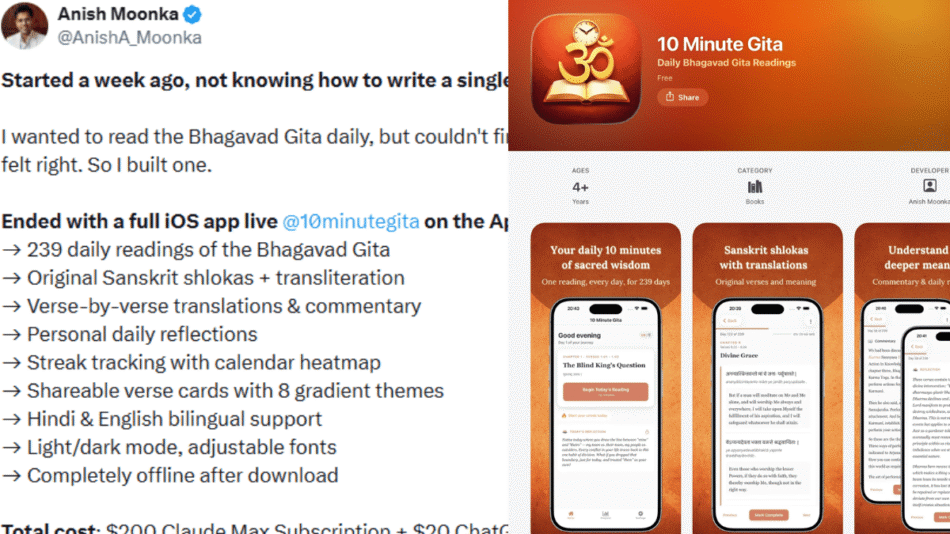
I Built a Bhagavad Gita App for $319 in 4 Days (No Coding Required)
The rapid advancement of artificial intelligence (AI) has revolutionized the way software is developed, enabling individuals without coding expertise to create functional applications. A recent example is the creation of a Bhagavad Gita app, developed in just four days for a mere $319.
This app, named ’10 Minute Gita’, showcases how generative AI tools can empower non-technical users to bring their ideas to life, challenging traditional notions of software development and engineering.
Continue Reading
The Journey of Building the App
The creator of the ’10 Minute Gita’ app, Anish Moonka, embarked on this project with no prior coding experience. His motivation stemmed from a personal desire to engage with the Bhagavad Gita daily but finding existing apps lacking in features and user experience.
In just four days, he managed to launch a fully functional iOS app on the Apple App Store. The total cost incurred was $319, which included:
- $200 for a subscription to Claude Max, an AI tool designed for coding assistance.
- $20 for a subscription to ChatGPT Pro, which provides advanced conversational capabilities.
- $99 for the developer fee required by Apple to publish apps on the App Store.
Features of the ’10 Minute Gita’ App
The app offers users a comprehensive experience with the Bhagavad Gita, featuring:
- 239 daily readings from the Bhagavad Gita.
- Original Sanskrit shlokas along with transliterations.
- Verse-by-verse translations and insightful commentary.
- Streak tracking with a calendar heatmap to encourage daily reading.
- Offline access after download for convenience.
- Bilingual support in Hindi and English.
- Shareable verse cards for users to share their favorite teachings.
As of now, the app is available exclusively on the iOS platform and has received initial feedback from users.
The Role of AI in Software Development
This development highlights a significant shift in the software engineering landscape, where AI tools like Claude Code and OpenAI’s Codex are transforming how applications are built. The ability to generate code from plain English descriptions allows non-technical users to create sophisticated applications without needing to write code themselves.
Sridhar Vembu, the founder of Zoho, commented on this trend, suggesting that professionals who rely on coding for their livelihoods may need to consider alternative career paths. He noted that the emergence of AI-assisted software engineering is becoming increasingly prevalent, with complex programming tasks being handled effectively by AI systems.
Implications for the Future of Work
The emergence of AI in software development raises important questions about the future of work in the tech industry. Vembu outlined two potential futures:
- Decentralization: In this optimistic scenario, technology becomes so accessible and trivial that it allows individuals to focus on more meaningful aspects of life, such as family, culture, and community.
- Centralized Control: Conversely, a pessimistic view suggests that ownership and control of AI technologies could lead to monopolistic practices, where a few entities dominate the market and extract profits from AI systems.
As AI continues to evolve, the implications for software roles will likely increase, pushing the boundaries of what is possible for non-coders.
Conclusion
The creation of the ’10 Minute Gita’ app serves as a powerful example of how AI is democratizing software development. By enabling individuals without technical backgrounds to create functional applications, AI tools are reshaping the landscape of app development and challenging traditional notions of coding.
Frequently Asked Questions
The ’10 Minute Gita’ app is an iOS application that provides users with daily readings from the Bhagavad Gita, including original Sanskrit shlokas, translations, and commentary.
The app was developed using AI tools like Claude Max and ChatGPT Pro, which allowed the creator to generate code and build the app by describing requirements in plain English.
The total cost of building the app was $319, which included subscriptions to AI tools and the developer fee for publishing on the Apple App Store.
Note: The rise of AI in software development presents both opportunities and challenges, reshaping the future of work in the tech industry.