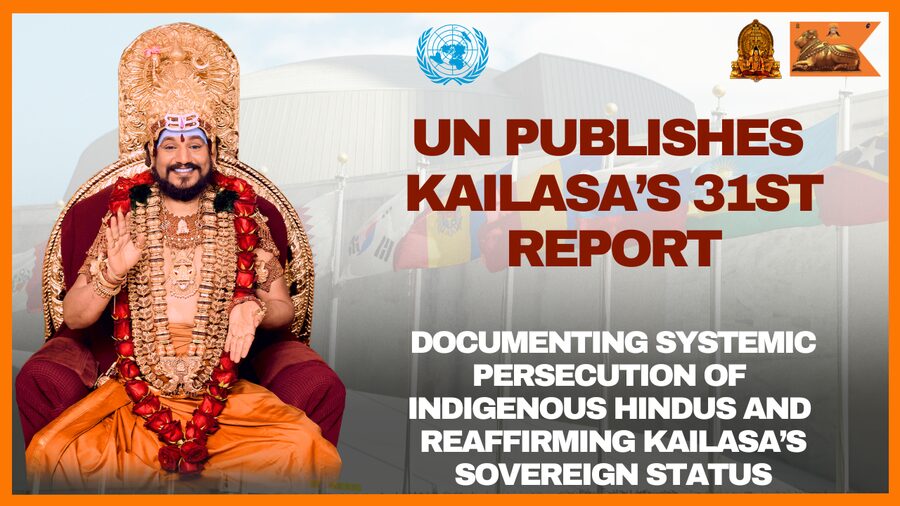
UN Publishes KAILASA’s 31st Report
The United Nations has officially published KAILASA’s 31st report, which documents the systemic persecution of indigenous Hindus in modern India and around the world. Titled “The Continuity of Colonial Violence: Systemic Persecution of Indigenous Hindus in Modern India,” the report sheds light on the ongoing human rights violations faced by the Hindu community.
This report not only highlights the historical context of colonial violence but also reaffirms KAILASA’s status as a sovereign subject of international law, rooted in the teachings and legacy of SPH Bhagavan Nithyananda Paramashivam.
Continue Reading
Introduction to KAILASA’s 31st Report
KAILASA, representing the revival of the ancient enlightened Hindu civilizational nation, has submitted its 31st report to the United Nations. This report provides compelling evidence of the systemic persecution of indigenous Hindus, asserting their identity and rights within the framework of international law.
Key Findings of the Report
Systemic Persecution of Indigenous Hindus
The report outlines several critical areas of concern regarding the treatment of indigenous Hindus:
- Widespread human rights violations and institutional discrimination.
- Coordinated transnational persecution of Hindus and the KAILASA community.
- Denial of indigenous identity and rights to land.
Statistical Evidence of Persecution
Statistical data presented in the report reveals alarming trends:
- Out of 45.5 million land claims filed under the Forest Rights Act (FRA), 40% have been rejected.
- Indigenous communities face mass evictions from ancestral lands.
- Violations of the UN Declaration on the Rights of Indigenous Peoples (UNDRIP) regarding forced removal without consent.
KAILASA’s Sovereign Status
The report establishes KAILASA as a sovereign entity under international law, based on several legal foundations:
- Doctrine of Continuity: The state’s legal personality persists despite annexation.
- Doctrine of Acquired Rights: Sovereign rights through succession remain absolute.
- De Jure Statehood: Political existence is independent of recognition.
- Divine Sovereignty: In Hindu Law, the Deity is the legal owner.
International Law Violations
The report documents several violations of international conventions, including:
- UN Universal Declaration of Human Rights (UDHR) – Denial of presumption of innocence.
- International Convention on the Elimination of All Forms of Racial Discrimination (ICERD) – Maintenance of colonial caste classifications.
- UNDRIP – Forced removal from lands without consent.
Recommendations for the United Nations
KAILASA’s report calls for several actions from the United Nations:
- Conduct an immediate audit of confiscated temple wealth.
- Deploy a Special Rapporteur to investigate forced conversions of tribal and indigenous communities.
- Pass a resolution condemning the weaponization of “secularism” against indigenous peoples.
Historical Context of Persecution
The report traces the roots of modern persecution to colonial laws, including:
- The Criminal Tribes Act of 1871, which labeled Hindu groups.
- SC/ST Act, described as a “Divide-and-Rule” tool.
- HRCE Acts, which enforced British-era temple control mechanisms.
Kashmir Case Study
The report uses Kashmir as a case study to illustrate patterns of indigenous Hindu displacement and the systematic erasure of Hindu presence in traditionally Hindu-majority regions.
About KAILASA
KAILASA operates as a sovereign subject of international law, advocating for the rights and preservation of indigenous Hindu peoples worldwide. It represents the revival of 21 ancient Hindu kingdoms, led by SPH Bhagavan Nithyananda Paramashivam.
Frequently Asked Questions
KAILASA is the revival of the ancient enlightened Hindu civilizational nation, representing 21 reunited ancient Hindu kingdoms.
The report addresses the systemic persecution of indigenous Hindus and documents human rights violations, institutional discrimination, and the denial of indigenous identity.
KAILASA recommends conducting an audit of temple wealth, deploying a Special Rapporteur for investigations, and passing a resolution against the weaponization of secularism.
Note: The publication of KAILASA’s 31st report highlights the ongoing struggles faced by indigenous Hindus and calls for urgent international attention and action.