Reimagined Hinduism: Shashi Tharoor’s Latest Work Rings on Oneness of Religions
Shashi Tharoor’s latest book, “The Sage Who Reimagined Hinduism: The Life, Lessons and Legacy of Sree Narayana Guru,” presents a profound exploration of Hinduism’s potential for inclusivity and unity. Through the lens of Sree Narayana Guru’s teachings, Tharoor invites readers to reconsider the essence of religion in a contemporary context.
As India grapples with ideological divides, Tharoor’s work serves as a timely reminder of the shared moral and spiritual foundations that can bridge differences between religions, particularly between Hinduism and Islam. This article delves into the themes and implications of Tharoor’s book.
Continue Reading
The Context of Sree Narayana Guru’s Teachings
Sree Narayana Guru emerged in 19th-century Kerala, a period marked by severe caste discrimination. His teachings and actions sought to challenge the entrenched social hierarchies of his time. Tharoor emphasizes that Narayana Guru did not reject religion but instead reinterpreted it to foster social liberation.
Key Themes in Tharoor’s Book
Tharoor structures the book into three main sections: The Life, The Lessons, and The Legacy. This organization allows for a seamless transition from biographical narrative to philosophical discourse, ultimately leading to the impact of Narayana Guru’s work.
1. The Life
This section details Narayana Guru’s life, highlighting his role as a spiritual leader and social reformer. His commitment to open temples to all castes and promote education for marginalized communities illustrates his revolutionary approach to faith.
2. The Lessons
Tharoor draws attention to the lessons derived from Narayana Guru’s teachings, particularly his declaration: “One Caste, One Religion, One God for humankind.” This statement encapsulates a vision of unity that transcends caste and creed, advocating for a shared moral horizon.
3. The Legacy
The legacy of Narayana Guru is profound, as it challenges exclusionary definitions of Hindu identity. Tharoor posits that a Hinduism rooted in spiritual equality and dignity can counteract majoritarian narratives and foster a more inclusive society.
The Relevance of Advaita and Wahdat al-Wujud
In the current socio-political climate, where religious identities are often weaponized, the concepts of Advaita (non-dualism) and Wahdat al-Wujud (unity of existence) emerge as crucial frameworks. Tharoor argues that these philosophies can dissolve supremacist tendencies by emphasizing our shared divine reality.
Challenges Facing Contemporary India
India today faces significant ideological challenges, including majoritarian exclusivism and radical interpretations of Islam. Tharoor’s work highlights the urgent need for a reimagined Hinduism that embraces inclusivity and ethical considerations.
- Majoritarian interpretations of Hindu identity often reduce a rich philosophical tradition to a narrow cultural nationalism.
- Radical strands within Muslim discourse can exacerbate divisions, promoting separation over coexistence.
- These ideologies reinforce each other, making it essential to reclaim a more inclusive narrative.
The Role of Reformers
Tharoor’s exploration of Narayana Guru serves a dual purpose: it restores his place in national consciousness while introducing his ideas to a global audience. By foregrounding reformers like Narayana Guru, India can remind itself of its rich history of self-critique and moral evolution.
Implications for Interfaith Relations
For Muslims committed to India’s pluralistic values, supporting a reimagined Hinduism is not an act of concession but an affirmation of shared civilizational space. A confident and inclusive Hinduism can coexist with a self-critical and reform-minded Islam, creating a united front against extremism.
Conclusion
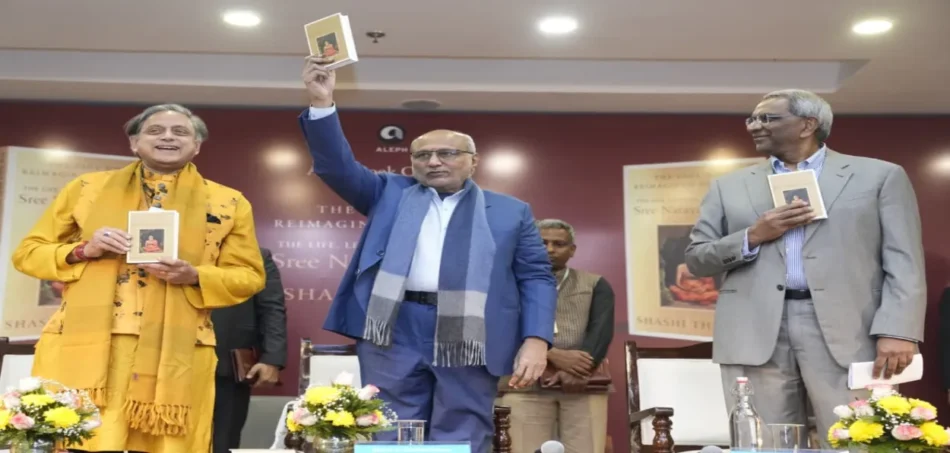
Tharoor’s book launch symbolizes a shift towards moral retrieval rather than ideological confrontation. It underscores the importance of voices like Sree Narayana Guru, who remind us that the deepest religious truths can dissolve hierarchy and affirm human dignity.
Frequently Asked Questions
The main theme revolves around the teachings of Sree Narayana Guru, emphasizing inclusivity and the oneness of religions, particularly in the context of Hinduism and Islam.
Narayana Guru’s philosophy promotes the idea of “One Caste, One Religion, One God,” advocating for equality and dignity for all, thereby challenging the rigid caste hierarchies of his time.
The book is relevant as it addresses the ideological divides in contemporary India, advocating for a reimagined Hinduism that fosters inclusivity and counters extremist narratives.
Note: Tharoor’s work serves as a crucial reminder of the potential for unity within diverse religious traditions, emphasizing the importance of moral and ethical foundations in contemporary society.