Muslim Family in Punjab Village Donates Land for Temple Construction
In a remarkable display of interfaith harmony, a Muslim family in Jhampur village, Punjab, has donated land for the construction of a temple. This gesture follows a similar trend where the Sikh community has contributed to the establishment of mosques in the region, showcasing a spirit of unity among different religious groups.
The donation of a 325-square-yard plot, valued at Rs. 80 lakh, reflects the long-standing tradition of cooperation and support among communities in Punjab, emphasizing the importance of religious tolerance and mutual respect.
Continue Reading
Background of the Donation
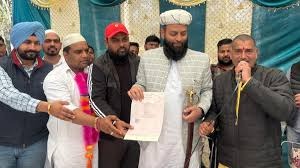
The donation was made by Mohammed Imran, a 37-year-old real estate businessman, who formally handed over the land documents to the temple committee on February 12, 2026. The local Hindu residents had approached various community leaders, expressing the need for a space to build a temple due to the growing population in the village.
Maulana Mohammed Usman Rehman Ludhianvi, the Shahi Imam of Punjab, attended the ceremony, highlighting the significance of this act in fostering interfaith relations. Imran’s gesture is a testament to the collaborative spirit that exists among the diverse communities in Punjab.
Community Reactions
The response from the local Hindu community has been overwhelmingly positive. Pandit Raja Ram, a representative of the Hindu residents, expressed profound gratitude towards Imran and the Shahi Imam for their support. He emphasized the importance of unity among different faiths, stating:
“I always say that no one is a Hindu, Muslim, Sikh, or Christian among us. We are all brothers.”
This sentiment was echoed by other community members, who noted that despite their religious identities, they prioritize their humanity and shared experiences over sectarian divisions.
The Vision Behind the Donation
Imran articulated his vision for the future, stating that his goal is to support the community in various ways, including healthcare. He mentioned plans to open a hospital to provide medical treatment for the underprivileged. His previous contributions include the construction of a mosque and a church, illustrating his commitment to fostering an inclusive environment.
Imran’s dedication to interfaith cooperation is further highlighted by his remarks on the necessity of mutual respect for religious sentiments:
“When places of worship can be built for non-Muslims in Islamic countries, respecting their sentiments, why can’t we do the same here?”
Construction Plans for the Temple
The temple will comprise two main structures: a Hanuman temple built on three marlas and a Sanatan Dharma temple on ten marlas of land. Imran’s friend, Sanjay Jindal, will collaborate with him on this project, ensuring that the construction aligns with the architectural styles of previously built temples in the area.
The temple committee has expressed its commitment to ensuring that the construction process is inclusive, inviting participation from all community members, regardless of their religious affiliations.
Significance of the Gesture
This donation is not just a land transfer; it symbolizes a broader message of peace and cooperation among different faiths. It serves as an example for other communities, showcasing how collective efforts can lead to a harmonious society. The act of donating land for a temple by a Muslim family is a powerful reminder of the potential for interfaith collaboration in addressing community needs.
In a world often divided by religious differences, this act of generosity stands as a beacon of hope, encouraging others to engage in similar acts of kindness and understanding.
Frequently Asked Questions
The Muslim family, led by Mohammed Imran, decided to donate land for the temple after local Hindu residents expressed the need for a space to build a temple due to the growing population in the village.
The temple will consist of a Hanuman temple built on three marlas and a Sanatan Dharma temple on ten marlas of land, with construction plans involving community participation.
This event highlights the long-standing tradition of interfaith harmony in Punjab, showcasing how different communities can come together to support each other’s religious needs and promote mutual respect.
Note: This act of generosity serves as a powerful reminder of the potential for interfaith collaboration in fostering a harmonious society.