Sikhs Flock to See Rare Outing of Ancient Holy Book in Edinburgh
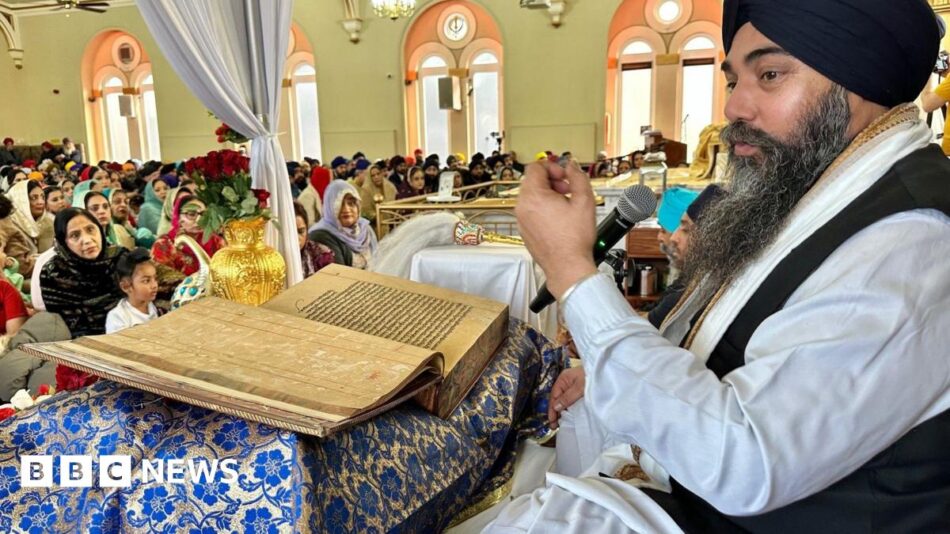
In a momentous occasion for the Sikh community in Scotland, a rare outing of the ancient holy scripture, the Guru Granth Sahib, drew crowds to the Edinburgh Gurdwara in Leith. This event marked the first time in 175 years that this sacred text was allowed to leave the University of Edinburgh’s archives.
Discovered in 2020, the handwritten Guru Granth Sahib is believed to date back to the 1700s, making it the oldest of its kind in the UK. The event not only celebrated the scripture’s historical significance but also provided an emotional connection for the Sikh community.
Continue Reading
The Discovery of the Guru Granth Sahib
The Guru Granth Sahib, a central religious scripture of Sikhism, was found in the archives of the University of Edinburgh during a digital file review by academics. This significant find has been described as a treasure for the Scottish Sikh community.
Originally belonging to Maharaja Kharak Singh, the ruler of Punjab, the scripture was taken during the capture of the fort at Dullewalla in India in 1848. It was later presented to the university by Sir John Spencer Login, who also famously brought the Koh-I-Noor diamond to Queen Victoria.
Significance of the Event
The event at Edinburgh Gurdwara was not only a rare opportunity to view the scripture but also a celebration of Sikh heritage and identity. The Guru Granth Sahib was transported in a special convoy, highlighting its fragility and importance. A no-flash photography rule was enforced to protect the delicate manuscript.
As the scripture arrived, it was carried through the crowd amidst a vibrant display of Sikh and Scottish flags, accompanied by traditional music from a bagpiper. The atmosphere was filled with reverence and joy, as community members gathered to witness this historic moment.
Ceremonial Observances
During the ceremony, a volunteer waved a ceremonial whisk called a chaur sahib over the Guru Granth Sahib, symbolizing respect and reverence. The priest, Giyani Himit Singh, led prayers, reading from the sacred text to the congregation.
The event was described as emotional, with many attendees expressing their joy and connection to the scripture. Galab Singh Gold, a member of the Edinburgh Gurdwara, remarked on the significance of the occasion, stating that it was a once-in-a-lifetime opportunity to see something that had been lost to history.
Community Perspectives
Trishna Kaur-Singh, the honorary Sikh chaplain at Edinburgh University, emphasized the importance of keeping the scripture in Scotland. She expressed that while discussions on repatriation are valid, the Sikh community in Scotland has developed its own ties to the scripture and its history.
Harmanpreet Kaur, a young attendee who traveled from Glasgow, expressed her excitement, stating, “It is a privilege to get the opportunity to bow down to a Guru Granth Sahib that is 300 years old.” This sentiment was echoed by many who felt honored to witness the scripture’s presence.
Preservation and Future Research
Rachel Hosker, an archivist at the University of Edinburgh, highlighted the need for further research on the Guru Granth Sahib. She noted that the university lacked a comprehensive understanding of its significance prior to its discovery and that collaboration with the Sikh community was essential for its proper appreciation and care.
Letters from 1851, found alongside the scripture, have provided some context, but ongoing research is expected to uncover more about its history and importance.
Frequently Asked Questions
The Guru Granth Sahib is the central religious scripture of Sikhism, containing hymns and writings of Sikh Gurus and other saints.
This outing is significant as it marks the first time in 175 years that the Guru Granth Sahib has been allowed to leave the university, providing a rare opportunity for the Sikh community to connect with their heritage.
Further research is being conducted to understand its history better, and there is a desire within the Sikh community for it to remain in Scotland for future generations.
Note: The event was a poignant reminder of the importance of cultural heritage and the connections that bind communities together. It serves as an opportunity for reflection on the past and a celebration of the present.